What Does Introvert Mean? Every Parent of a Quiet Child Needs to Hear
Introvert is not just a word — it is a report card of your character.
I always write what I experience in my own life, so today this topic came to my mind when I was not able to understand my daughter’s behaviour. Today she is a teenager, but extremely quiet, someone who loves solitude, dislikes social circles, and stays silent at parties and gatherings. In the beginning I thought everything would become normal, but whenever I met other children, they seemed quite active, cheerful and confident — and then I would fall into thought: is my daughter in depression? Is someone troubling her? Because she would not mix with anyone. Then sometimes I would think — is she feeling lonely because she is a single child? Or as a parent, is she unhappy with us? So many questions were creating a storm in my mind.
But I held myself together and typed some of my daughter’s symptoms and wanted to ask ChatGPT — things like:
My daughter prefers alone time. She gets tired after social events. She has few but deep friendships.
Is my daughter in depression?
And then I received quite a reassuring answer — “Your daughter is absolutely normal. She is simply an introvert child.”
And that was it. I grabbed that one word — introvert — and began researching it deeply.
See, I am not a child specialist. I am an ordinary mother who, out of worry for her daughter, found her way to the word introvert. So in this article, I want to help all those parents who have introverted children — by sharing my own experience with them.
Come, let us first begin with the symptoms — so that you can recognize whether your child is an introvert or not.
Symptoms of an Introverted Child
Before I share what I discovered, let me give you a simple checklist. Go through it slowly — and see how many points match your child.

1. She prefers alone time over group play While other children are running around in groups, your child is happiest in her own corner — reading, drawing, or simply sitting quietly. This is not loneliness. This is her natural state of peace.
2. Social gatherings drain her energy After a birthday party or family function, she comes home looking exhausted — not physically, but somewhere deep inside. Crowds do not excite her. They tire her.
3. She has very few but very deep friendships She is not the child with twenty friends. She is the child with one or two — but those friendships are loyal, deep, and real in a way most people never experience.
4. She thinks before she speaks She will never be the loudest voice in the room. She observes first, processes quietly, and speaks only when she truly means it.
5. She loves her own company Give her a book, a journal, or just a quiet afternoon — and she is completely content. Solitude is not punishment for her. It is oxygen.
6. She finds small talk difficult Casual conversations with strangers or distant relatives feel uncomfortable and exhausting for her. But sit her down for a real, meaningful conversation — and she will surprise you completely.
7. She takes time to open up She will not warm up to new people quickly. But once she trusts you — she trusts you with everything.
8. She is extremely self-aware Introverted children feel things very deeply. They notice details others miss. They carry emotions quietly inside — which is why as parents, we sometimes worry they are hiding something painful.
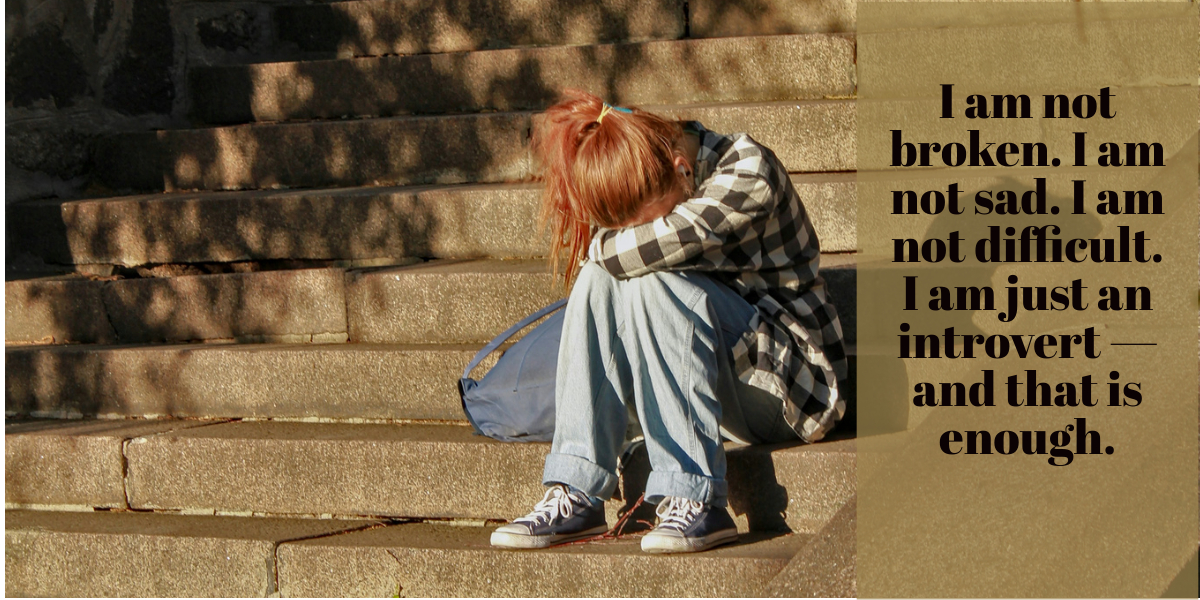
If you found yourself nodding at five or more of these points — your child is most likely an introvert. And I want you to hear this clearly: she is not broken. She is not depressed. She is simply wired differently — and that difference is beautiful.
What to Do Once You Know Your Child is an Introvert
1. Change Your Own Mindset First
I remember the day I realized the problem wasn’t my daughter. The problem was the lens I was using to look at her.
We carry so much without knowing it — years of being told that loud means confident, that social means successful, that quiet means something is wrong. I carried all of that into my parenting without even realizing it. And my daughter felt the weight of it every single day.
The work begins inside us. Not in our children. Before you read another parenting tip, sit with this one question: Do I actually believe my introverted child is whole, as she is right now? Not when she speaks more. Not when she makes more friends. Right now. If the honest answer is not fully yes — that is where you begin.
2. Respect Her Need for Solitude
There is something I had to learn the hard way.
When she walked into her room and closed the door, it was not a closed door on me. It was an open door to herself. She was doing something essential — something I had never been taught to value — she was returning to her own center.
Think about the last time you were truly exhausted. What did you need? Maybe a cup of chai in silence. Maybe five minutes where nobody asked you anything. That is what her room is. That is what her quiet is. It is not absence. It is restoration. And the most loving thing you can do is guard that space for her — not interrupt it, not feel rejected by it, but simply say: this is hers, and it matters.
3. Stop Pressuring Her to Perform Socially
I have seen the look on a child’s face when she is pushed into a room full of people she is not ready for.
It is not shyness. It is not stubbornness. It is the look of someone who is being asked to run a race with no warning, no preparation, and no finish line in sight. And the worst part? She blames herself for not being able to run it.
So try this instead. Before the next family gathering, sit with her. Tell her who will be there. Tell her it is okay to sit quietly. Tell her you will leave by a certain time. Give her one small thing to look forward to — maybe the food, maybe one cousin she actually likes. A child who walks into a room with a map in her hand is a completely different child from one who is pushed through the door and told to figure it out.
4. Connect With Her in Her Own Language
I used to wonder why my daughter never talked to me at dinner.
Then one evening we were washing dishes together — side by side, hands busy, no eye contact — and she told me something about her day that she had never told me sitting across a table. I almost dropped the plate.
Introverted children open up sideways. Not face to face. Not under a spotlight. They talk when their hands are doing something else, when the pressure of being watched is gone, when conversation feels like a gentle stream instead of a direct question. Find that stream with your child. A walk. A drive. Cooking. Folding laundry. Show up in the quiet spaces — and then wait. She will come.
5. Name Her Strengths Out Loud
Here is something I believe with everything I have.
Children become what we call them. Not in a magical way — in a deeply ordinary, everyday way. The words we use about our children, in front of them and behind them, become the voice inside their head for the rest of their lives.
So name what you see. Tell her: you notice things others miss. Tell her: when you love someone, you love them completely. Tell her: your mind goes deeper than most people’s. Say it simply. Say it often. Say it in the language of your home — Hindi, English, both, whatever reaches her heart fastest. Because she is listening. She is always listening. And she is deciding, slowly, what she believes about herself. Let your words tip that scale toward worthiness.
6. Explain Introversion to Her
The day I told my daughter what introversion meant, something shifted in her face.
Not dramatically. Not like a movie moment. Just — quietly. Like a small knot coming undone.
Because she had been living inside a feeling she had no name for. She knew she got tired at parties. She knew she needed her room. She knew she preferred one friend to ten. But without a name for it, all of that just felt like something is wrong with me. The name changed everything. Suddenly it was not a flaw. It was a fact. A neutral, scientific, interesting fact about how her brain works. Give your child that name. Give her books about it if she likes to read. Show her famous introverts — scientists, writers, artists. Let her see that the world is full of people like her, doing extraordinary things, in their own quiet way.
7. Advocate for Her at School
Nobody fights for the quiet child.
That is the truth I had to face. The loud child gets noticed — for better or worse. The quiet child gets overlooked. She sits in the middle of a classroom, processing everything deeply, understanding more than anyone realizes — and she gets a remark on her report card that says needs to participate more.
Go to her school. Talk to her teacher — not defensively, but as a partner. Say: my daughter thinks before she speaks. She may need a moment. She may do better contributing in writing. Ask if she can be given a heads-up before being called on. Ask if her quietness is being mistaken for disengagement. You are not asking for special treatment. You are asking for accurate understanding. There is a difference. And your daughter needs at least one adult at school who sees her clearly. If that adult does not exist yet — help create one.
8. Forgive Yourself Too
I want to end this section the way I began this whole journey — honestly.
I have not been a perfect parent to my introverted daughter. I have pushed when I should have waited. I have worried out loud when I should have been quiet. I have compared her — just in my own head, but still — to children who seemed easier to understand. I have felt, on hard days, a small impatient wish that she was just a little bit different.
I am not proud of those moments. But I am not ashamed of them either. Because they are human. Because parenting an introverted child when you do not fully understand introversion is hard. Because we are all just trying, with the knowledge we have, in the time we have.
The fact that you read this far — that you typed her symptoms into a search box because you were worried, that you stayed up wondering if you were doing enough — that is not the behavior of a parent who is failing. That is the behavior of a parent who loves their child enough to keep learning.
And that, in the end, is everything.
Give her a home where who she is, is enough.
If you read this whole article, I already know one thing about you.
You are a good mother.
Not because you have all the answers. But because you cared enough to look for them. You typed your daughter’s name into a search box — not to change her, but to understand her. That is not a small thing. That is everything.
Your quiet daughter does not need to become someone else. She does not need more friends, more confidence, or a louder voice. She needs exactly what you are already learning to give her — a home where she does not have to explain herself.
That is your job. And you are already doing it.
So the next time she walks past you and disappears into her room — let her go. Smile a little. Because you know now what that closed door really means.
She is not pulling away from the world.
She is coming back to herself.
And that is exactly where she is supposed to be.