- Posted on September 29, 2026
- By Jyoti Yadav
- In Minimalist lifestyle
10 Minimalist Habits That Helped Me Stop Scrolling
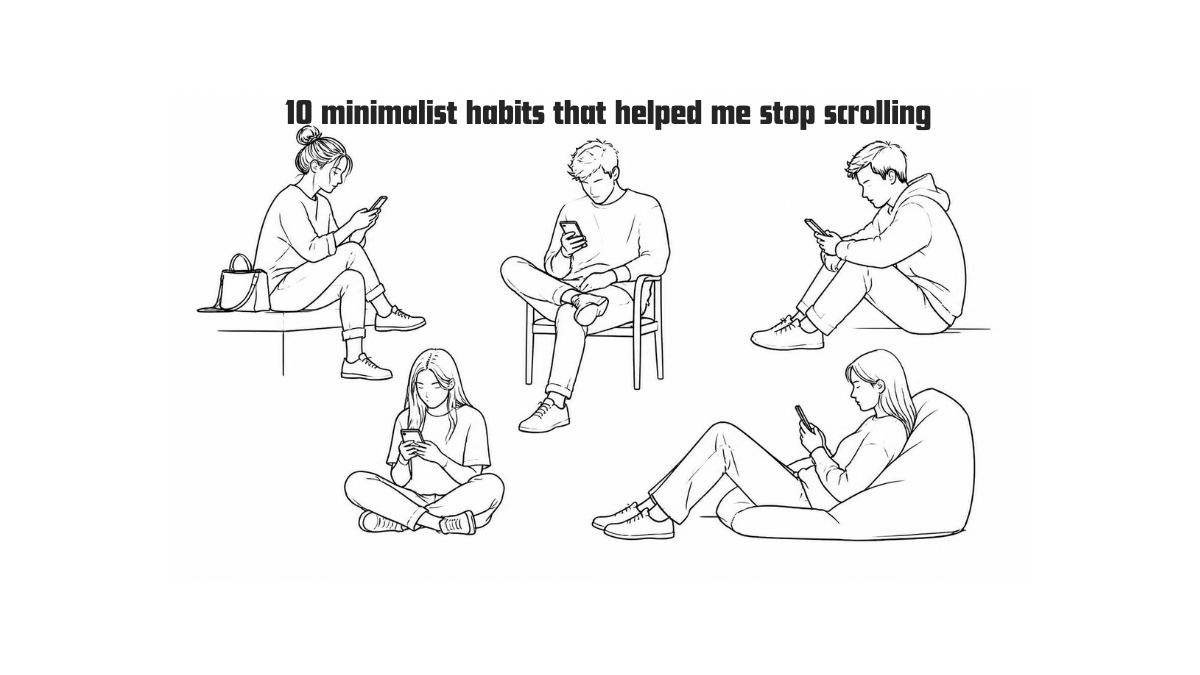
Today I noticed a strange habit in myself, and I started wondering how many people go through the same thing without ever paying attention to it.
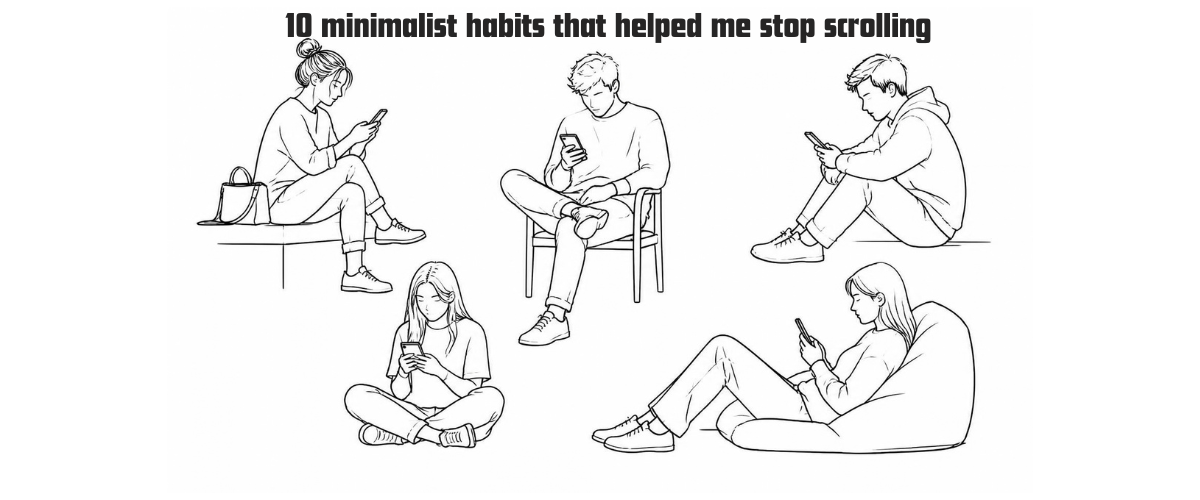
Two free minutes show up, and before I’ve even thought about it, my phone is in my hand and I’m scrolling social media.
Got a short break at work? Scroll.
Eating a meal? Scroll.
Lying in bed? Scroll.
Someone is talking to me? The phone is still in my hand.
And then, at the end of the day, we complain:
“The day went by so fast. I don’t even know where it all went.”
But when I took a closer look at my daily pattern, I realised an uncomfortable truth.
My work hadn’t increased. My free time was being stretched thin by scrolling.
A two-minute break would sometimes turn into 30 minutes.
That’s when I realised: if I wanted a simpler and more beautiful life, I needed to stop scrolling unnecessarily.
Why Is It So Difficult to Stop Scrolling?
Social media isn’t a bad thing in itself.
We use it to stay connected, learn new things, discover ideas, follow people we love, and sometimes simply relax.
The problem begins when we are no longer choosing to use it. We are using it automatically.
Recent research shows just how common frequent digital use has become. In a 2025 Pew Research Center survey of U.S. adults, 41% said they use the internet almost constantly, while another 43% said they go online several times a day.
Deloitte’s 2024 Connected Consumer research also found that 74% of Gen Z and 68% of millennials surveyed checked social media feeds at least several times a day. The same research reported that some consumers were checking their smartphones very frequently throughout the day.
And this behaviour isn’t limited to social media
Deloitte’s 2026 Ireland research now reports 70% saying they spend too much time on their phones, while 60% look at their phone within 15 minutes or less of waking and 82% check their phone at least 10 times a day.
These surveys don’t mean that everyone who checks their phone frequently has a problem. But they do show how easily phones have become part of our everyday routines.
For me, the answer wasn’t to quit social media completely.
It was to bring minimalism into my phone habits.
10 Minimalist Habits That Helped Me Stop Scrolling
These are the simple changes I started making after noticing my own patterns.
1. I Stopped Picking Up My Phone the Moment I Woke Up
This was probably one of my biggest habits.
Earlier, waking up almost meant:
Open my eyes → pick up phone → check notifications → open social media → start scrolling.
Before my day had even started, someone else’s content had already entered my mind.
So I stopped making my phone the first thing I reached for in the morning.
Now I try to give myself some quiet time before entering the digital world.
It could be having water, opening the curtains, making tea, stretching, praying, journaling, or simply sitting quietly.
A simple morning routine doesn’t need a screen.
2. I Stopped Using Social Media as My Default Way to Relax
This one was harder than I expected.
After working for a while, I would feel tired and think:
“I’ll just check social media for five minutes.”
But those five minutes rarely stayed five minutes.
One reel became another.
Then another.
And suddenly half an hour was gone.
So I started asking myself:
“Am I actually tired, or am I simply looking for stimulation?”
Sometimes what I really needed was a cup of tea, a short walk, silence, or just a place to sit down.
Rest doesn’t always have to mean scrolling.
3. I Stopped Scrolling While Eating
Mealtime should be a natural pause for me, not another opportunity to consume content.
Earlier, my phone would be in my hand and I would scroll while eating.
Now I try to eat without my phone.
It sounds like a very small change, but it makes meals feel different.
I notice the food.
I eat more mindfully.
And most importantly, I am not dividing my attention between my meal and someone else’s life on a screen.
4. I Stopped Taking My Phone to Bed
Bed should mean winding down.
But when the phone comes to bed, “just five minutes” can easily turn into much longer scrolling.
So I started creating a little distance between myself and my phone at night.
Instead of scrolling, I may read, talk to my husband, think about my day, or simply sleep.
A minimalist lifestyle is not only about having fewer things around you.
Sometimes it’s about having fewer distractions between you and rest.
5. I Started Giving My Family My Full Attention
This one made me realise how much I was missing without even knowing it.
Sometimes my husband is asking me something.
Sometimes my children are telling me about their day.
And I’m answering them while still scrolling.
Technically, I am answering them.
But am I really present?
There is a big difference between hearing someone and giving them your attention.
So I started putting my phone down when my family is talking to me.
Because no social media post is more important than a real conversation happening right in front of me.
6. I Stopped Turning Two Minutes Into Thirty
This was the biggest realisation for me.
I used to think:
“I only have two minutes.”
So I would open social media.
But social media didn’t stay within those two minutes.
A short gap became 10 minutes.
10 became 20.
And sometimes 20 became 30.
My work wasn’t necessarily taking longer.
My small pockets of free time were disappearing.
Now, when I have two minutes, I allow them to remain two minutes.
I may simply sit.
Look outside the window.
Take a few deep breaths.
Drink water.
Or do nothing.
Not every empty moment needs to be filled.
7. I Turned Off Unnecessary Notifications
Every notification is an invitation to look.
And if we respond to every invitation, our attention never really belongs to us.
So I started turning off notifications that weren’t genuinely important.
No constant alerts.
No unnecessary interruptions.
No feeling that I need to check my phone every few minutes.
This is one of the simplest forms of digital minimalism.
8. I Made Social Media Less Convenient
I didn’t delete every social media app.
Instead, I made them slightly harder to access.
I moved them away from my home screen and removed some apps I wasn’t actually using.
Why?
Because I wanted to create a tiny pause between “I feel bored” and “I am scrolling.”
That pause matters.
It gives me a chance to ask:
“Do I really want to open this, or am I doing it automatically?”
9. I Started Allowing Myself to Be Bored
This sounds strange, but boredom can be useful.
Earlier, even waiting for someone for two minutes felt like a reason to take out my phone.
Now I am trying to become comfortable with those little moments of nothing.
Sometimes I sit with my tea.
Sometimes I watch the sky.
Sometimes I simply let my thoughts wander.
A simple life has empty spaces.
We don’t need to fill every one of them.
10. I Started Choosing What Deserves My Attention
This is perhaps the most important minimalist habit of all.
Minimalism isn’t only about asking:
“What can I remove from my home?”
It can also mean asking:
“What can I remove from my attention?”
I don’t need to see every reel.
I don’t need to follow every trend.
I don’t need to know what everyone is doing.
I don’t need to respond to every notification immediately.
And I certainly don’t need to turn every two-minute break into a thirty-minute scrolling session.
My attention is limited.
So I want to spend it on things that actually matter to me.
I Didn’t Quit Social Media—I’m Learning to Use It Differently
I don’t think we need to stop using social media completely.
It can be useful, entertaining and even inspiring.
The goal is not:
“Never scroll again.”
The goal is:
“Stop scrolling unnecessarily.”
That’s a very different approach.
For me, minimalist living means being intentional about what I allow into my life, including what I allow onto my phone.
I still use social media.
I still enjoy it.
But I don’t want every moment of boredom, tiredness or silence to automatically lead me there.
What Changed After I Started to Stop Scrolling?
The biggest change wasn’t that I suddenly had hours and hours of extra time.
It was that I became more aware of where my time was going.
I started noticing conversations.
I enjoyed meals more.
I became comfortable with silence.
I had fewer random interruptions.
And I stopped feeling that every free minute had to be filled with something.
Most importantly, I realised something very simple:
Sometimes we don’t need more time. We need fewer distractions.
And that’s where minimalism can make a difference, not by asking us to remove everything, but by helping us decide what deserves a place in our lives.
Frequently Asked Questions
How can I stop scrolling social media unnecessarily?
Start by identifying when you automatically reach for your phone. Create phone-free moments around waking up, meals, family conversations and bedtime. Turning off unnecessary notifications and moving social media apps away from your home screen can also create a pause before you start scrolling.
Why do I keep scrolling even when I don’t want to?
Scrolling can become an automatic response to boredom, stress, tiredness or having a few free minutes. Recognising your trigger is the first step. Instead of immediately reaching for your phone, pause and ask yourself what you actually need at that moment.
How do I stop scrolling at night?
Keep your phone away from your bed, create a screen-free period before sleeping, and replace scrolling with something calming such as reading, journaling or talking with your family.
How do I stop scrolling when I’m bored?
You don’t necessarily need to eliminate boredom. Try allowing yourself to sit without your phone for a few minutes. You can drink tea, walk, look outside, stretch, read or simply do nothing.
How can I stop scrolling without deleting social media?
You can set specific social media times, turn off notifications, remove apps from your home screen, create phone-free zones and avoid using social media during meals, family time and before bed.
Why does five minutes of scrolling turn into 30 minutes?
Because social media provides a continuous stream of new content. There is always another post, reel or video waiting. Creating a deliberate stopping point and making the app less immediately accessible can help break this automatic pattern.
A Simple Reminder Before You Scroll
The next time you have two free minutes and your hand automatically reaches for your phone, pause.
Ask yourself:
“Do I actually want to scroll, or am I simply uncomfortable with having nothing to do?”
You don’t have to throw your phone away.
You don’t have to quit social media.
You don’t even have to become a perfect digital minimalist.
Just start noticing.
Because sometimes, the first step to a simpler life is simply putting the phone down.